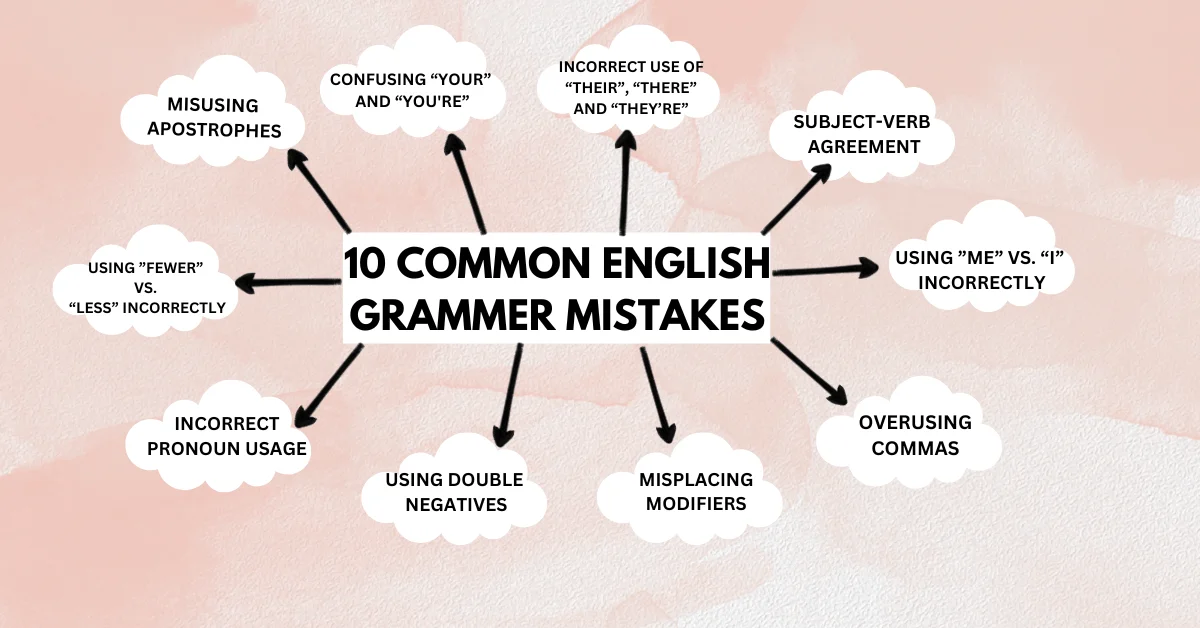
Common English Grammar Mistakes and How to Fix Them – English grammar is not always easy, even for people who use English every day. Many learners make the same mistakes again and again, not because they are careless, but because English has rules that feel confusing or inconsistent. The good news is that most grammar mistakes are common and easy to fix once you understand why they happen.
In this article, we will talk about common English grammar mistakes and how to fix them in a simple, practical way. This guide is useful for students, bloggers, writers, and anyone who wants to sound more natural and confident in English.
Subject-Verb Agreement Errors
Subject-verb agreement is one of the most common grammar problems in English writing. The basic rule is simple: a singular subject needs a singular verb, and a plural subject needs a plural verb. However, many people still get confused, especially when sentences become longer.
Singular and Plural Confusion
A common mistake happens when the subject and verb are separated by extra words. For example, someone might write, “The list of items are on the table.” This sounds natural to many learners, but it is actually incorrect. The real subject is “the list,” which is singular, so the correct sentence is “The list of items is on the table.”
To fix this mistake, always identify the main subject of the sentence and ignore extra phrases in the middle.
Indefinite Pronouns Mistakes
Words like everyone, someone, nobody, and each are singular, even though they refer to many people. Many writers mistakenly use plural verbs with these words. For example, “Everyone have their own opinion” is incorrect. The correct version is “Everyone has their own opinion.”
Incorrect Use of Tenses
Tense mistakes can make your writing confusing and unclear. English has many tenses, and choosing the wrong one can change the meaning of a sentence.
Mixing Past and Present Tense
One common error is switching tenses in the same sentence or paragraph without reason. For example, “Yesterday I go to the store and bought some food.” This sentence mixes present and past tense incorrectly.
To fix this, make sure all verbs match the time you are talking about. The correct sentence is “Yesterday I went to the store and bought some food.”
Present Perfect vs Past Simple
Many learners struggle with the difference between present perfect and past simple. A common mistake is using past simple when the time is not specific. For example, “I saw that movie already” is less natural. The correct sentence is “I have already seen that movie.”
Use present perfect when the exact time is not mentioned and the action is connected to the present.
Wrong Use of Articles
Articles a, an, and the are small words, but they cause big problems for English learners. Many languages do not use articles the same way English does.
Missing Articles
A very common mistake is leaving out articles completely. For example, “She is teacher” sounds wrong in English. The correct sentence is “She is a teacher.”
Whenever you talk about a singular, countable noun, you usually need an article.
Overusing “The”
Another common mistake is using “the” when it is not necessary. For example, “I love the nature” is incorrect. The correct sentence is “I love nature.”
Use “the” only when you are talking about something specific or already known.
Preposition Mistakes
Prepositions are tricky because there are many of them, and their usage is often idiomatic. Even advanced English users make mistakes with prepositions.
Wrong Preposition Choice
A common example is saying “married with” instead of “married to.” Another example is “interested on” instead of “interested in.”
The best way to fix this mistake is exposure and practice. Read and listen to natural English as much as possible, and notice which prepositions are used with certain words.
Unnecessary Prepositions
Sometimes learners add prepositions where they are not needed. For example, “discuss about the problem” is incorrect. The correct sentence is “discuss the problem.”
Always check whether a verb actually needs a preposition or not.
Confusing Similar Words
English has many words that look or sound similar but have different meanings. Mixing them up is a very common grammar mistake.
Your vs You’re
This is one of the most popular mistakes in both writing and online communication. “Your” shows possession, while “you’re” means “you are.” Writing “Your welcome” instead of “You’re welcome” is incorrect.
To avoid this mistake, replace the word with “you are” and see if the sentence still makes sense.
Their, There, and They’re
These three words sound the same but have completely different uses. “Their” shows possession, “there” refers to a place, and “they’re” means “they are.”
Mistakes with these words can make your writing look careless, so always double-check them before publishing.
Sentence Structure Problems
Poor sentence structure can make even correct grammar hard to understand. Many writers struggle with run-on sentences and sentence fragments.
Run-On Sentences
A run-on sentence happens when two or more sentences are joined without proper punctuation. For example, “I like English it is easy to learn” should be “I like English because it is easy to learn” or split into two sentences.
To fix this, use periods, commas with conjunctions, or rewrite the sentence more clearly.
Sentence Fragments
A sentence fragment is an incomplete sentence. For example, “Because I was tired.” This sentence is missing a main clause.
Make sure every sentence has a subject and a verb and expresses a complete idea.
Capitalization and Punctuation Errors
These mistakes may seem small, but they affect readability and professionalism.
Capitalization Mistakes
Some writers forget to capitalize the first word of a sentence or proper nouns like names, countries, and days. Writing “i live in london” looks unprofessional. The correct sentence is “I live in London.”
Comma Misuse
Commas are often overused or underused. One common mistake is forgetting a comma after an introductory phrase. For example, “After work I go to the gym” is better written as “After work, I go to the gym.”
Final Thoughts on Improving English Grammar
Making grammar mistakes is a normal part of learning English. Even native speakers make errors sometimes. The key is awareness and practice. When you understand common English grammar mistakes and how to fix them, you will write with more confidence and clarity.
Reading a lot, writing regularly, and reviewing your work can make a big difference. Over time, correct grammar will feel natural, not forced. Keep learning, keep practicing, and do not be afraid to make mistakes along the way.