British vs American Grammar Differences
British vs American Grammar Differences – English is a global language, but it is far from uniform. Two of its most influential varieties, British English and American English, share the same roots yet differ in many subtle and not-so-subtle ways. For learners, writers, and website owners, understanding British vs American grammar differences is essential for clarity, consistency, and credibility.
These differences do not usually block communication, but they can affect how professional or natural your writing sounds. In SEO-focused content, especially for niche sites and PBNs, consistency in grammar style helps search engines and readers trust your content more.
This article explores the most important grammar differences between British and American English in a simple, practical way.
Why British and American English Are Not Exactly the Same
British English developed earlier and was shaped by historical usage in the United Kingdom. American English evolved after English arrived in North America, influenced by immigration, local culture, and language simplification over time.
As a result, American English tends to favor efficiency and regularity, while British English often preserves traditional forms. These distinctions appear clearly in grammar, spelling, and sentence construction.
Understanding which version you are using matters, especially when your audience is primarily from the US or the UK.
Verb Forms and Tense Usage
Present Perfect vs Simple Past
One of the most noticeable grammar differences lies in how the present perfect tense is used.
British English uses the present perfect more frequently to describe recent actions or experiences with present relevance. For example, a British speaker might say, “I have just finished my work.”
American English often prefers the simple past in the same situation, saying, “I just finished my work.”
Both forms are grammatically correct, but mixing them within the same article can feel inconsistent. For SEO writing, choosing one style and sticking with it is highly recommended.
Past Participles and Irregular Verbs
Some verbs have different past participle forms in British and American English. In British English, “learnt,” “dreamt,” and “burnt” are commonly used. American English favors “learned,” “dreamed,” and “burned.”
Neither is wrong. However, American English generally prefers regular verb endings, while British English is more flexible with irregular forms.
Collective Nouns and Subject Agreement
Collective nouns such as team, staff, government, or family behave differently in the two varieties.
British English often treats collective nouns as plural, especially when emphasizing individuals within the group. For example, “The team are playing well today.”
American English almost always treats collective nouns as singular, focusing on the group as a unit. The American version would be, “The team is playing well today.”
This difference affects verb agreement and pronoun usage. Mixing styles can make sentences sound awkward or unpolished.
Prepositions and Grammar Structures
Differences in Preposition Usage
Prepositions are a common source of confusion. British and American English use different prepositions in many everyday expressions.
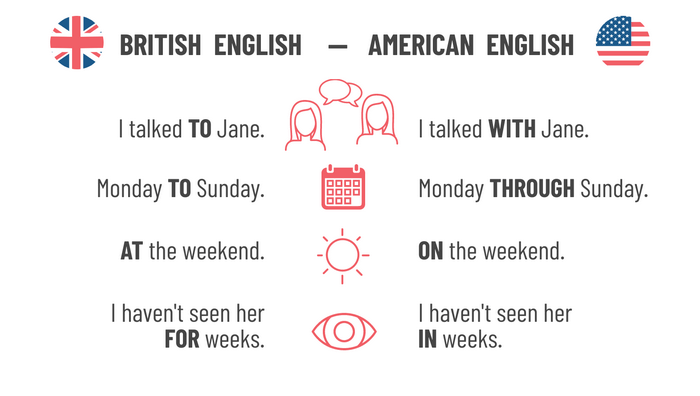
British English speakers say “at the weekend,” while American English uses “on the weekend.” Another example is “different to” or “different from” in British English, compared to the American preference for “different from” or “different than.”
These small differences may seem minor, but they add up. Search engines and native readers often subconsciously notice them.
Omission of Prepositions
American English sometimes omits prepositions that British English retains. For instance, Americans say “Monday through Friday,” while British speakers usually say “Monday to Friday.”
Again, consistency is more important than choosing one as “better.”
Use of Articles
Articles like “the,” “a,” and “an” are used slightly differently across the two varieties.
British English often includes “the” in phrases where American English drops it. A common example is “in hospital” versus “in the hospital.” British English focuses on the activity or condition, while American English refers more to the physical place.
The same pattern appears with “at university” and “at the university.”
Understanding this difference helps writers avoid sounding unnatural to their target audience.
Auxiliary Verbs and Modal Usage
Shall vs Will
“Shall” is more common in British English, especially in formal writing or polite suggestions. For example, “Shall we begin?”
In American English, “shall” is rare outside of legal or very formal contexts. Americans almost always use “will,” as in “Will we begin?”
If your content is aimed at a US audience, frequent use of “shall” can feel outdated or overly formal.
Need and Have Got
British English commonly uses “have got” to express possession, such as “I have got a new phone.” American English prefers the simpler “I have a new phone.”
Similarly, British English sometimes uses “needn’t,” while American English uses “don’t need to.”
Spelling Differences That Affect Grammar Perception
Although spelling is not grammar itself, it strongly influences how grammar is perceived.
British English uses spellings like “organise,” “colour,” and “centre.” American English prefers “organize,” “color,” and “center.”
Mixing spelling systems within the same article is one of the fastest ways to lose credibility, especially for SEO-focused websites. Choose one standard and apply it consistently across all pages.
Punctuation and Quotation Marks
British and American English differ in punctuation rules, particularly with quotation marks.
British English often places punctuation outside quotation marks unless it is part of the quoted material. American English almost always places commas and periods inside quotation marks.
For example, American English writes: She said, “It’s done.”
British English may write: She said, “It’s done”.
While subtle, these details matter for professional-level writing.
Which Grammar Style Should You Use for SEO?
From an SEO perspective, American English is generally more dominant due to the size of the US market and search volume. However, British English is more appropriate if your audience is based in the UK, Australia, or other Commonwealth countries.
The key rule is not which version you choose, but how consistently you apply it. Search engines value clarity, coherence, and user experience. Mixing British and American grammar can reduce readability and trust.
For PBN content, clean grammar, natural flow, and a clear language identity help pages look more authentic and less automated.
Final Thoughts on British vs American Grammar Differences
British and American English are two sides of the same coin. Their grammar differences reflect history, culture, and evolving language habits rather than strict right or wrong rules.
By understanding these distinctions, writers can produce more natural, targeted, and effective content. Whether you choose British or American grammar, consistency is your strongest asset.
For SEO and PBN purposes, well-structured writing with a clear grammatical identity not only improves rankings but also builds long-term credibility with readers and search engines alike.