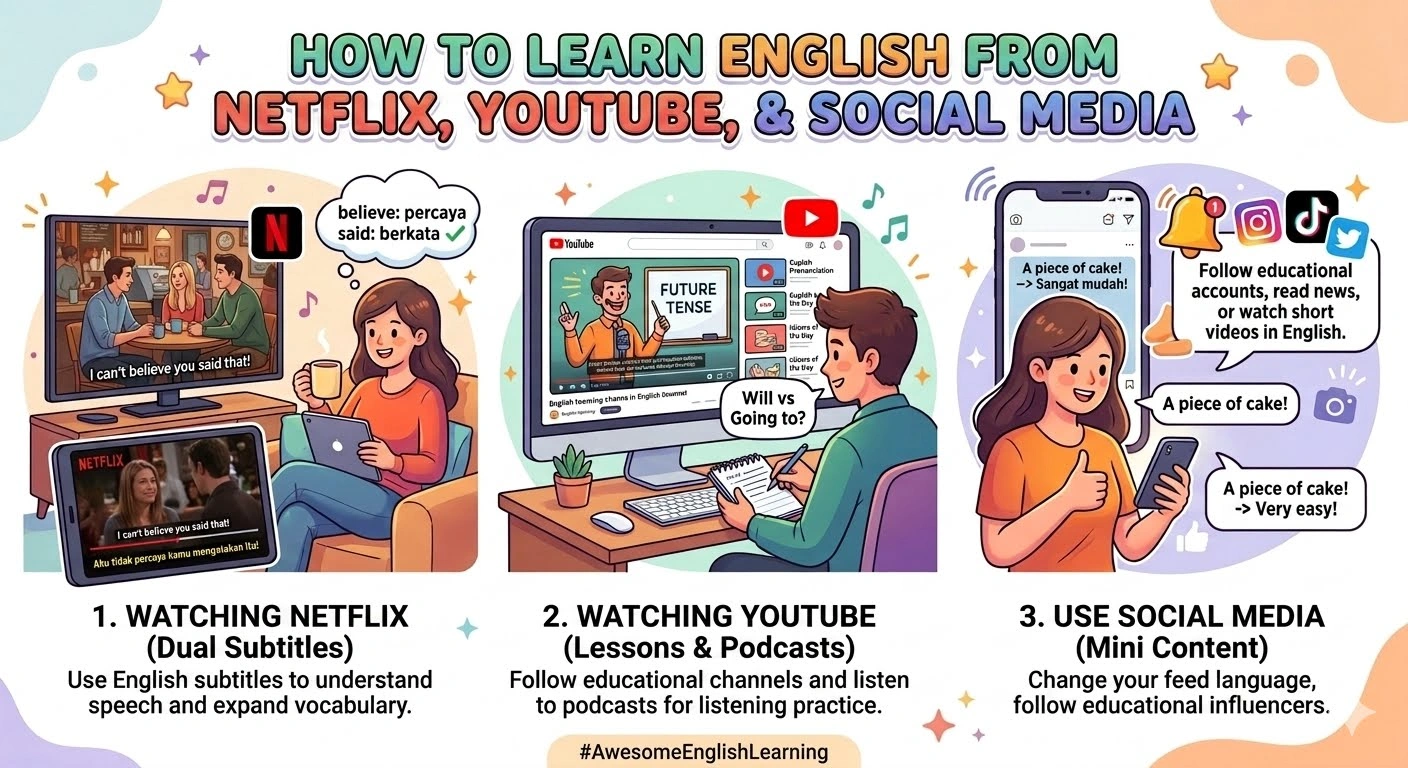
How to Learn English From Netflix, YouTube, and Social Media
How to Learn English From Netflix, YouTube, and Social Media | Learning English no longer has to mean spending hours memorizing vocabulary from textbooks. Today, you can improve your English naturally through entertainment and content you already enjoy. Netflix, YouTube, and social media provide thousands of videos, conversations, interviews, and stories that can help you develop your English skills.

The key is not simply watching or scrolling. You need to use these platforms actively so that you are listening, learning new expressions, and practicing how native speakers communicate.
Here is how to learn English from Netflix, YouTube, and social media effectively.
Why Learn English Through Netflix, YouTube, and Social Media?
Traditional English lessons can be useful, but real-world content gives you something textbooks often cannot: authentic English.
When you watch movies, series, or online videos, you hear how people actually speak. You can learn:
- Common vocabulary
- Everyday expressions
- Pronunciation
- Different accents
- Slang and informal English
- Sentence patterns
- Conversation skills
- Listening comprehension
Another advantage is motivation. If you enjoy watching movies or following creators online, learning English can become part of your daily routine rather than feeling like a formal study session.
How to Learn English From Netflix
Netflix can be an excellent tool for improving listening and vocabulary. However, simply watching an entire series without paying attention to the language may not produce significant improvement.
Instead, turn entertainment into an active learning exercise.
1. Choose a Series You Actually Enjoy
Start with a show that interests you. Comedy, drama, documentaries, reality shows, and other genres can all be useful.
Choosing something you genuinely enjoy makes it easier to stay consistent.
If the dialogue is too difficult, start with a series that uses relatively simple everyday conversations.
2. Use English Subtitles
English subtitles can help you connect spoken words with their written forms.
For example, if you hear:
“I’m running late.”
You can immediately see how the sentence is written and understand that “running late” means being late or not arriving on time.
Try to avoid relying completely on subtitles in your native language.
English subtitles encourage your brain to connect sound, spelling, and meaning.
3. Pause and Record Useful Expressions
You do not need to write down every unfamiliar word.
Instead, focus on phrases that you could realistically use in daily conversations.
For example:
- “What do you mean?”
- “Are you serious?”
- “Give me a second.”
- “I’ll take care of it.”
- “That makes sense.”
- “I’m not sure about that.”
Learning complete expressions is often more useful than memorizing isolated vocabulary.
4. Repeat Interesting Lines
Choose a short sentence from the show and repeat it several times.
Try to copy:
- Pronunciation
- Rhythm
- Intonation
- Speed
- Word linking
This technique can help make your English sound more natural.
You do not need to imitate every accent perfectly. The goal is to become comfortable producing English sounds and sentence patterns.
How to Learn English From YouTube
YouTube provides an enormous amount of English-learning material. More importantly, you can choose videos that match your interests.
This makes YouTube particularly useful for building vocabulary around specific topics.
1. Watch Videos About Your Interests
If you enjoy technology, watch technology channels.
If you like gaming, watch gaming content.
If you enjoy cooking, watch English-language cooking channels.
When you already understand the topic, it becomes easier to guess the meaning of unfamiliar words from context.
2. Start With English Videos That Are Slightly Difficult
Do not immediately choose extremely advanced content.
A good video should challenge you without making you understand almost nothing.
If you understand most of the video but still encounter unfamiliar expressions, it can be an excellent learning resource.
3. Use the Playback Speed Feature
If native speakers talk too quickly, slow the video down.
Try 0.75x speed when necessary. Once you become more comfortable, return to normal speed.
Eventually, you want to understand natural English without slowing the video down.
4. Practice Shadowing
Shadowing is a useful technique for improving pronunciation and speaking.
Listen to a short sentence and immediately repeat it while trying to match the speaker.
For example:
Speaker: “I’ve been working on this project all week.”
You: “I’ve been working on this project all week.”
Repeat the sentence several times until the pronunciation and rhythm feel more natural.
How to Learn English From Social Media
Social media can also become an English-learning environment.
Instagram, TikTok, X, Facebook, Reddit, and other platforms expose you to short pieces of authentic English every day.
The advantage is that social media content is usually short, making it easy to practice consistently.
1. Follow English-Speaking Creators
Change your feed intentionally.
Follow creators who produce content in English and cover topics you enjoy.
After some time, your feed will naturally contain more English content.
This gives you regular exposure without requiring a separate study session.
2. Read Comments
Comments can be surprisingly useful for learning informal English.
People often use abbreviations, slang, jokes, and conversational expressions.
For example:
- “That’s hilarious.”
- “No way!”
- “I can’t believe this.”
- “This is so relatable.”
- “You’ve got a point.”
These expressions can help you understand how English is used casually online.
3. Write Comments in English
Reading is useful, but producing English is even better.
Try leaving short comments in English.
You do not need to write complicated sentences.
Start with something simple:
“This was really helpful. Thanks for sharing!”
The goal is to make English production a normal part of your daily routine.
Create an English-Only Entertainment Routine
One of the easiest ways to stay consistent is to create a simple daily routine.
For example:
15 minutes of Netflix + 15 minutes of YouTube + 10 minutes of social media
You could divide your practice like this:
| Activity | Main Skill |
|---|---|
| Netflix | Listening and expressions |
| YouTube | Listening and pronunciation |
| Social media | Reading and informal vocabulary |
| Commenting | Writing |
| Shadowing | Speaking and pronunciation |
You do not need to study for several hours every day.
Consistency is more important than occasional intensive sessions.
Don’t Translate Every Word
One common mistake is stopping every few seconds to translate vocabulary.
This can make learning slow and frustrating.
Instead, try to understand the general meaning first.
If you encounter the sentence:
“We need to figure this out.”
You may understand the situation even if you do not know the exact meaning of “figure out.”
From context, you can infer that it means finding a solution or understanding something.
Only look up words that are:
- Repeated frequently
- Important to understanding the content
- Useful in everyday conversations
- Relevant to your interests
Keep a Personal Vocabulary List
When you find useful expressions, save them somewhere.
Your list could look like this:
| Expression | Meaning | Example |
|---|---|---|
| Figure out | Find a solution or understand | “I need to figure out what happened.” |
| Give me a second | Wait briefly | “Give me a second, please.” |
| That makes sense | I understand/agree | “Okay, that makes sense.” |
| No worries | It’s okay | “No worries, I can help.” |
Focus on phrases rather than collecting hundreds of individual words.
Use the Same Content More Than Once
You do not always need new content.
Watching the same short scene twice can be more beneficial than watching two completely different scenes once.
On the first viewing, focus on understanding.
On the second viewing, pay attention to:
- Pronunciation
- Vocabulary
- Grammar
- Sentence structure
- Intonation
You may be surprised by how much more you notice the second time.
Turn Passive Watching Into Active Learning
There is a major difference between passive and active learning.
Passive learning:
Watch a movie for two hours and forget most of the language.
Active learning:
Watch a short scene, identify useful expressions, repeat sentences, and use new vocabulary in your own examples.
You do not have to turn every movie into a classroom exercise. Even spending 10–15 minutes actively studying language during your entertainment can make a difference.
Common Mistakes to Avoid
Watching Content That Is Too Difficult
If you understand almost nothing, learning becomes frustrating.
Choose content that is challenging but understandable.
Using Native-Language Subtitles All the Time
Subtitles in your native language can make it easy to ignore the English audio.
Use English subtitles when possible.
Memorizing Too Many Words
A huge vocabulary list is not useful if you never use the words.
Focus on practical expressions.
Never Speaking
Listening and reading are important, but speaking requires practice.
Repeat sentences aloud and try using new expressions in conversations.
Studying Only When You Feel Motivated
Language learning works better as a habit.
Ten minutes every day can be more sustainable than two hours once a week.
A Simple 30-Day English Learning Plan
You can start with a simple routine.
Week 1: Listening
Watch 15–20 minutes of English content every day.
Use English subtitles and focus on understanding the main idea.
Week 2: Vocabulary
Write down five useful expressions each day.
Create your own example sentences.
Week 3: Pronunciation
Choose several short sentences from Netflix or YouTube and practice shadowing.
Week 4: Speaking and Writing
Leave English comments, write short posts, or talk to yourself in English using the expressions you have learned.
At the end of the month, review your vocabulary and compare your listening ability with your first week.
Final Thoughts
Learning English from Netflix, YouTube, and social media can be both effective and enjoyable when you use these platforms intentionally.
Netflix can help you understand conversations and everyday expressions. YouTube allows you to explore topics that interest you while practicing listening and pronunciation. Social media gives you exposure to short, informal English and opportunities to read and write naturally.
The most important thing is consistency.
You do not need perfect grammar before starting. You do not need to understand every word. Simply make English part of your daily entertainment and gradually turn passive exposure into active practice.
With regular listening, repetition, reading, and speaking, the English you encounter online can eventually become English you can confidently use yourself.

Grammar Ain’t That Deep: English for Stand-Up
Grammar Ain’t That Deep: English for Stand-Up | Stand-up comedy is not just about having a funny idea. It is about how you say it. The right words, timing, rhythm, and delivery can turn an ordinary sentence into a punchline. That is why understanding English is important for stand-up comedy—but grammar does not always have to be perfect.

In fact, some of the funniest comedians deliberately break grammar rules to make their jokes sound more natural, surprising, or relatable. Grammar ain’t that deep when the audience understands the joke and the delivery works.
Why English Matters in Stand-Up Comedy
English is full of expressions, slang, idioms, and wordplay. Comedians use these elements to create jokes that sound natural and conversational.
A technically correct sentence may be grammatically perfect but still sound boring on stage. Meanwhile, a sentence that breaks a grammar rule can sometimes get a bigger laugh because it sounds unexpected.
For stand-up comedians, the goal is not always to speak like a textbook. The goal is to communicate an idea clearly while creating a reaction from the audience.
Grammar vs. Natural Speech
Traditional English lessons often teach students to construct perfect sentences. Stand-up comedy works differently.
People rarely speak in perfectly structured sentences during casual conversations. They use contractions, slang, fragments, repetition, and informal expressions.
For example:
“I was gonna go to the gym, but then I remembered I hate being healthy.”
The phrase “gonna” is informal, but it sounds natural in conversation. On stage, that natural quality can make the joke feel more authentic.
A comedian needs to understand the difference between incorrect English and intentional informal English.
That distinction is important.
Timing Is More Important Than Perfect Grammar
In stand-up, timing can be more powerful than grammar.
A comedian may pause before the final word of a sentence, repeat a phrase, or intentionally change the structure of a sentence to make the punchline stronger.
Consider a simple setup:
“My friend told me I need to exercise more.”
A comedian could add:
“So I started running… out of responsibilities.”
The grammar is simple. The humor comes from the unexpected meaning.
This is why comedians should think about rhythm and timing, not just sentence structure.
Why Comedians Break Grammar Rules
Breaking grammar rules can make a joke sound more personal and conversational.
Expressions such as “ain’t,” “gonna,” “kinda,” “y’all,” and “I ain’t got no…” are common in different varieties of spoken English. They may not be appropriate in formal academic writing, but they can be perfectly useful in comedy.
The key is understanding why you are using them.
If a comedian uses informal grammar because it matches their character, background, or comedic voice, it can strengthen the performance.
If they use it accidentally because they do not understand standard English, the result may not have the same effect.
Slang Can Make a Joke Stronger
Slang gives comedians another way to create personality.
Compare these two sentences:
Formal:
“I was extremely tired after work.”
Conversational:
“Man, I was dead after work.”
The second sentence is more casual and expressive. It sounds closer to how people actually talk.
Comedy depends heavily on voice. The words should sound like something the comedian would naturally say.
That is why learning slang and everyday expressions can be just as useful as studying grammar rules.
Word Choice Creates the Punchline
Sometimes one word can completely change a joke.
For example:
“My doctor told me to stop eating junk food.”
That sentence is ordinary.
Now imagine:
“My doctor told me to stop eating junk food. I told him, ‘Okay, but what am I supposed to eat while watching Netflix?’”
The humor comes from the contrast between healthy advice and an exaggerated everyday habit.
Comedians constantly search for words that create the strongest mental image. Simple English can often be more effective than complicated vocabulary.
English Idioms Are Great for Comedy
Idioms can create opportunities for jokes because their literal meanings are different from their intended meanings.
Expressions such as “break a leg,” “spill the beans,” “hit the road,” and “under the weather” can be funny when interpreted literally.
A comedian might take an ordinary expression and imagine what would happen if it actually meant what it said.
This technique is called literal interpretation, and it is a useful tool for creating jokes.
Learning English Through Comedy
Stand-up comedy can also be a fun way to improve English.
Instead of memorizing vocabulary lists, learners can listen to comedians and study how they use language in real conversations.
Pay attention to:
- Contractions
- Slang
- Idioms
- Pronunciation
- Pauses
- Sentence rhythm
- Wordplay
- Cultural references
- Tone and emphasis
Comedy can teach learners that English is not only about grammar rules. It is also about context, emotion, and intention.
The Difference Between Formal and Comedic English
Knowing when to use standard English is still important.
A job interview, academic essay, business presentation, or formal email usually requires more careful grammar. A comedy stage allows much more freedom.
A good comedian understands both worlds.
They know the rules well enough to break them intentionally.
That is the real lesson behind “Grammar Ain’t That Deep.” Grammar matters, but communication and creativity matter too.
How to Build Your Own Comedy Voice
If you want to perform stand-up in English, start by speaking naturally.
Do not try to sound like a dictionary. Do not force complicated vocabulary into your jokes. Instead, focus on telling stories and observations using words you actually understand and would normally use.
Then experiment with:
- Short sentences — They are easier to deliver and easier for audiences to follow.
- Unexpected words — Surprise creates comedic tension.
- Repetition — Repeating a phrase can make it funnier when the context changes.
- Pauses — Silence can build anticipation before a punchline.
- Informal language — Slang can make your performance feel more authentic.
- Exaggeration — Take a normal situation and push it to an absurd level.
The more you perform, the more you discover which language fits your comedic personality.
English for stand-up comedy is not about speaking perfect English all the time. It is about understanding how language works and knowing how to use it effectively.
Grammar ain’t that deep—but language is powerful.
A comedian can use perfect grammar, broken grammar, slang, idioms, or even silence to get a laugh. What matters most is whether the audience understands the idea, connects with the joke, and enjoys the performance.
So learn the rules. Understand the language. Then, when the joke needs it, break a few rules.
Because on the comedy stage, being understood and being funny often matter more than sounding perfect.