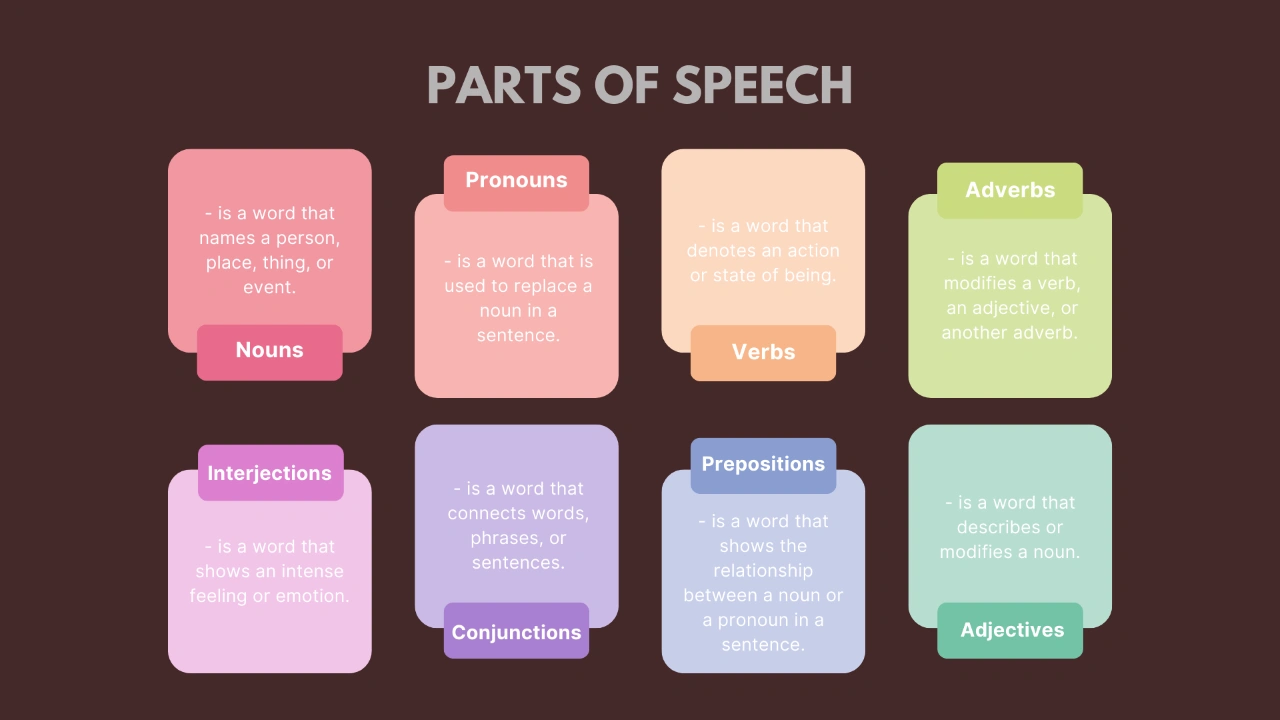
Mastering English Grammar: The 8 Parts of Speech | When diving into English layout, many learners immediately jump into memorizing complex tense formulas. However, there is a fundamental building block that you must master first: the Parts of Speech (Word Classes).
In English grammar, every single word we speak or write plays a specific role within a sentence. This role is what we call a part of speech. By understanding how these word classes function, you will not only construct grammatically correct sentences but also communicate with far greater confidence.
Let’s break down these eight essential elements of the English language, along with their rules and practical examples.
Understanding the 8 Elements of Parts of Speech
1. Noun
A noun is used to name a person, place, thing, or abstract idea. Nouns act as the anchor of a sentence.
-
The Rule: It can function as either a subject or an object. Nouns are divided into countable and uncountable forms.
-
Examples: Cat, London, Happiness, Book.
-
In a Sentence: “The cat slept on the chair.”
2. Pronoun
To keep sentences from sounding repetitive and tedious, we use pronouns to replace nouns.
-
The Rule: A pronoun must agree in number (singular or plural) with the noun it replaces.
-
Examples: I, you, they, he, she, it, this.
-
In a Sentence: “Siti is tired because she walked all day.”
3. Verb
Without a verb, a statement cannot be considered a complete sentence. Verbs express actions, occurrences, or states of being.
-
The Rule: Verbs change their form depending on the time of the action (tenses).
-
Examples: Run, is, writing, think.
-
In a Sentence: “They played football yesterday.”
4. Adjective
The primary job of an adjective is to modify, describe, or give more detail about nouns and pronouns.
-
The Rule: They are usually placed directly before the noun they describe.
-
Examples: Beautiful, smart, blue, huge.
-
In a Sentence: “He bought a beautiful watch.”
5. Adverb
While adjectives describe nouns, adverbs are tasked with modifying verbs, adjectives, or even other adverbs.
-
The Rule: They often (but not always) end with the suffix “-ly”.
-
Examples: Quickly, very, yesterday, everywhere.
-
In a Sentence: “She sang beautifully.”
6. Preposition
Prepositions function to show relationships of direction, time, location, or position between a noun and other words.
-
The Rule: They are always followed by a noun or pronoun object.
-
Examples: In, on, at, under, between.
-
In a Sentence: “The keys are on the table.”
7. Conjunction
Conjunctions act as the “glue” that connects words, phrases, or clauses together, ensuring the sentence flows logically.
-
The Rule: They are used to link equal grammatical elements or show cause-and-effect relationships.
-
Examples: And, but, because, although.
-
In a Sentence: “I wanted to go, but it started to rain.”
8. Interjection
An interjection is used to express sudden, spontaneous, or strong emotions.
-
The Rule: They usually stand alone or sit at the beginning of a sentence, followed by an exclamation mark or a comma.
-
Examples: Wow!, Ouch!, Oh, Well.
-
In a Sentence: “Wow! That performance was amazing.”
English Shape-Shifters: One Word, Multiple Roles
One unique aspect that frequently confuses beginners is the sheer flexibility of English words. A word is not always permanently locked into a single part of speech. Its role can shift entirely depending on how it is positioned within a sentence.
Take a look at how the word “work” changes:
-
As a Noun: “I have a lot of work to do.”
-
As a Verb: “I work at a tech company.”
Similarly, the word “well” can act as an adverb (“She speaks English well“), an adjective (“I am well“), or even a noun meaning a water source. Therefore, the secret to mastering this topic is not memorizing the dictionary, but rather understanding the sentence context.
Open Class vs. Closed Class
On a broader scale, these eight word classes are divided into two major categories:
-
Open Class: This group consists of words that constantly expand as time, culture, and technology evolve. It includes nouns, verbs, adjectives, and adverbs. For instance, modern terms like “googling” or “selfie” were naturally added over time.
-
Closed Class: This category contains words with a fixed count that rarely accept new additions. This includes pronouns, prepositions, conjunctions, and interjections.
Mastering the parts of speech is the most realistic first step if you want to write and speak English fluently. Once you comprehend how each element operates, constructing even the most complex sentences will feel significantly easier and more structured. Happy practicing in your daily learning routine!