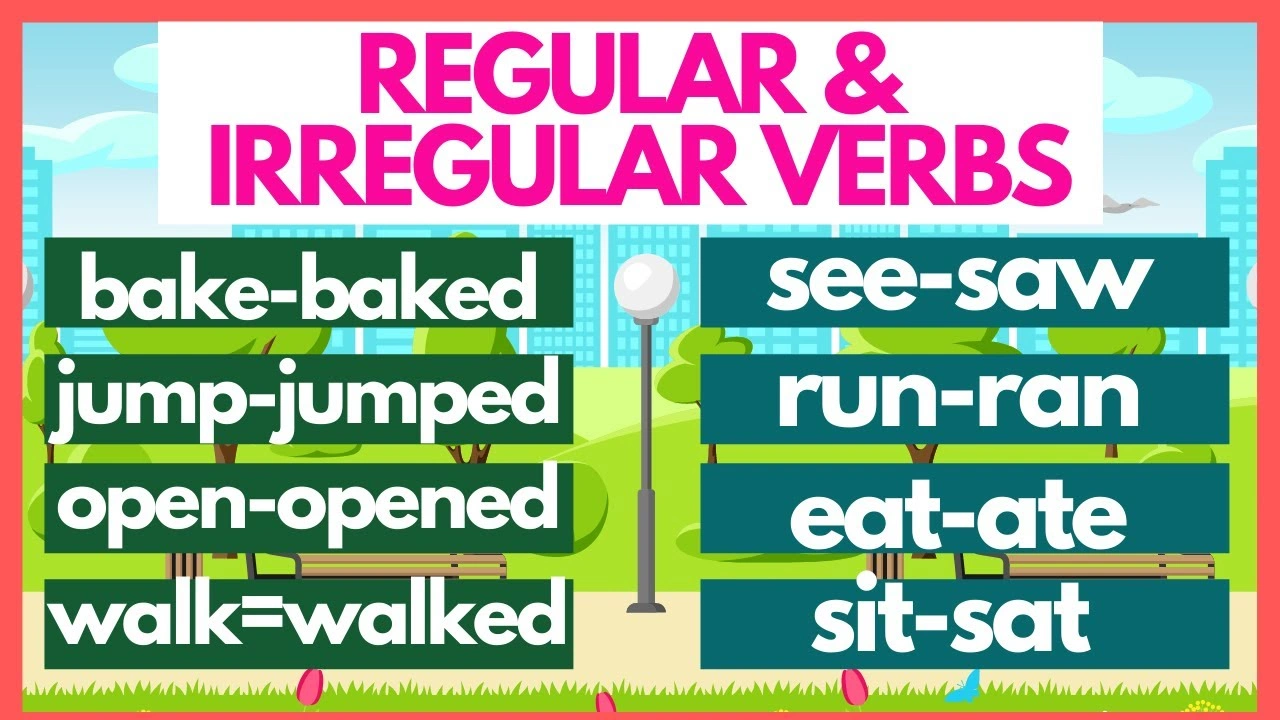
Regular vs Irregular Verbs: A Guide for Beginners | For anyone just starting to learn English, constructing sentences in the past tense often comes with its own set of challenges. Why does the word walk change into walked, while go suddenly transforms into went? Why can’t we just say goed?
These changes are not random coincidences. In English grammar, verbs are divided into two main categories based on how they change: Regular Verbs and Irregular Verbs. Understanding the fundamental differences between these two is the ultimate key to speaking and writing in English with confidence.
Let’s break down both verb groups in a simple yet thorough way, complete with their change patterns and easy ways to master them.
The Core Foundation: Why Do Verbs Change?
Before diving deeper, we need to understand why English verbs change form. Unlike some languages that only use time markers (like adding “yesterday” or “tomorrow” without changing the action word), English alters the structure of the verb itself to show tense.
Every English verb generally has three primary forms, often referred to as:
-
Verb 1 (Base Form): The fundamental or present tense form.
-
Verb 2 (Simple Past): Used to describe actions that were completed in the past.
-
Verb 3 (Past Participle): Used in perfect tenses (actions already completed) or passive voice sentences.
The core difference between regular and irregular verbs lies entirely in how they transition from Verb 1 to Verb 2 and Verb 3.
The First Group: Consistent Regular Verbs
Let’s start with the more beginner-friendly group. True to their name, regular verbs follow a strict, predictable rule. They do not like surprises. If you want to change them into their past tense or past participle forms, you simply add a specific suffix to the end of the base word.
The Golden Rule of Regular Verbs
Generally, the universal formula for regular verbs is incredibly straightforward:
Base Form (Verb 1) + “-ed” or “-d” = Past Tense (Verb 2 & Verb 3)
Let’s look at how this works in real-life examples:
-
Walk The base form is walk. Since it is a regular verb, we just add “-ed” to the end.
-
Present: I walk to school every day.
-
Past Tense: I walked to school yesterday.
-
Past Participle: I have walked to school many times.
-
-
Dance When a base verb already ends with the vowel “e”, we do not add another “-ed” to make it danceed. The correct rule is to simply add the letter “-d” to the very end.
-
Present: They dance gracefully.
-
Past Tense: They danced at the party last night.
-
Past Participle: They have danced together for years.
-
-
Play Just like the first example, this word combines directly with the “-ed” suffix to show that the playing activity happened in the past.
-
Present: Children play in the park.
-
Past Tense: Children played in the park this morning.
-
Past Participle: Children have played there since afternoon.
-
Small Spelling Variatons You Need to Know
Even though the pattern is highly consistent, there is a minor spelling adjustment you should keep in mind to avoid typos. This special rule applies if the base verb ends in a consonant followed by the letter “y”.
When you come across a verb with a consonant + “y” ending, you must drop or change the “y” to an “i” first, and only then add the “-ed” suffix.
As a clear example, look at the word Cry. This word ends with the consonant ‘r’ followed by the letter ‘y’.
-
Base Form: Cry
-
Spelling Shift: Change ‘y’ to ‘i’ (Cri)
-
Final Result: Cried
The exact same rule applies to words like Study which becomes Studied, or Try which becomes Tried. Keeping this small rule in mind ensures your English writing looks polished and professional.
The Second Group: Irregular Verbs and Their Surprises

Now we turn our attention to the group that often makes new learners scratch their heads. Irregular verbs are the rebels of the English language that refuse to follow the “-ed” formula. They prefer to pave their own path.
When moving from the base form to the past tense, irregular verbs change their internal vowel structure, alter their sound completely, or in some cases, do not change at all. Because they lack a consistent writing pattern, there is no mathematical formula to guess their forms. The best way to master them is through exposure and natural memorization.
The Unique Patterns of Irregular Verbs
Although they are called “irregular,” if you look closely, these verbs actually fall into a few predictable categories:
1. Verbs That Change Completely
These are verbs whose past tense forms look entirely different from their original words. You wouldn’t be able to guess their past forms if you hadn’t seen them before.
-
Go → Went (Verb 2) → Gone (Verb 3)
-
Eat → Ate (Verb 2) → Eaten (Verb 3)
-
Buy → Bought (Verb 2) → Bought (Verb 3)
2. Verbs That Change Internal Vowels
This type keeps the starting and ending letters mostly intact but changes the vowel sound in the middle to signal a shift in time.
-
Sing → Sang (Verb 2) → Sung (Verb 3)
-
Drink → Drank (Verb 2) → Drunk (Verb 3)
-
Run → Ran (Verb 2) → Run (Verb 3)
3. Verbs That Stay Exactly the Same
For many, this category is both the easiest and the most trickiest. These verbs experience absolutely no structural changes from Verb 1 to Verb 3. Telling them apart depends entirely on the context of the sentence or how they are pronounced.
-
Cut → Cut (Verb 2) → Cut (Verb 3)
-
Put → Put (Verb 2) → Put (Verb 3)
-
Read → Read (Verb 2) → Read (Verb 3) (Note: The spelling stays the same, but the pronunciation for Verb 2 and Verb 3 changes to sound exactly like the color “red”).
Effective Strategies to Master Both Verb Types
Looking at a massive list of irregular verbs might feel overwhelming, making you think you need to memorize thousands of words overnight. Fortunately, you don’t have to do that. These tactical steps will help embed these verb changes naturally into your memory:
Learn Through Contextual Stories
Memorizing a long, linear list of words is often boring and easily forgotten. Try reading short stories or articles in English instead. When you spot a past tense verb, underline it and find its base form. Our brains retain information much better when it is tied to a narrative context.
Group Irregular Verbs by Rhyme and Sound
Even though they are irregular, many of these verbs share similar transformation rhythms. You can group them into small clusters, such as the “Blow-Blew-Blown,” “Grow-Grew-Grown,” and “Throw-Threw-Thrown” group. Remembering words that rhyme puts far less strain on your brain.
Apply Them in Daily Practice
Every time you learn three to five new verbs, immediately use them to build your own sentences. Write a quick journal entry about your day using the past tense. Active, hands-on practice is the ultimate method for moving information from short-term memory into long-term retention.
Distinguishing between regular and irregular verbs is actually an engaging logical puzzle. Regular verbs offer the comfort of certainty through their fixed “-ed” or “-d” formulas. On the flip side, irregular verbs challenge us to be more observant and familiar with the quirks of the English language through internal adjustments.
The real key to mastering this is not instant perfection, but consistency in reading, listening, and practicing in daily communication. Over time, as your interaction with English increases, your instincts will take over, allowing you to choose the right verb form naturally without a second thought. Happy practicing!