A Beginner’s Guide to Using In, On, and At | For many English learners, figuring out when to use in, on, or at can feel like a guessing game. It makes sense why it is confusing. In many other languages, a single word can cover all these situations. You might use the same word for a city, a street, a specific time, or the top of a desk.
However, in English, that concept splits into three different choices. Picking the wrong one can make your sentences sound a bit unnatural to native speakers.
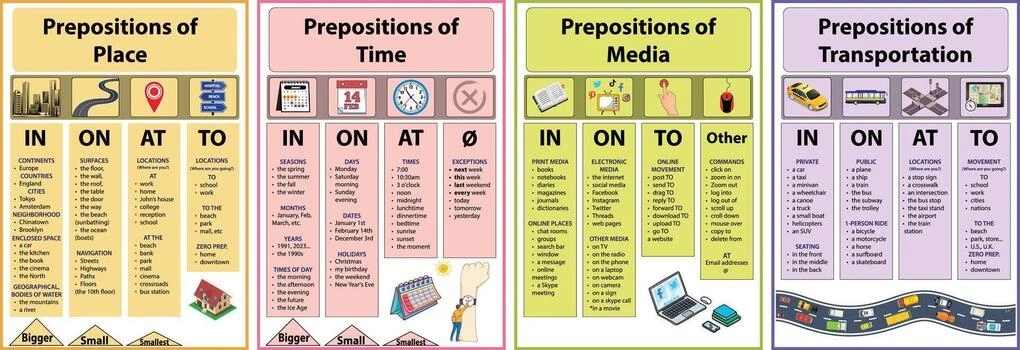
The good news is that mastering these three prepositions does not have to be painful. The biggest secret lies in scale and size. Picture an inverted pyramid: the wide top part represents large, general categories (In); the middle section covers medium, more specific groups (On); and the sharp point at the bottom is for tiny, exact points (At).
Let’s break down how this pyramid works for both time and place, using everyday examples to clear up the confusion once and for all.
Part 1: Showing Time from General to Specific
When talking about time, the golden rule is to look at the length of the period. The longer or broader the duration, the higher it sits on the pyramid. As the time becomes narrower and more precise, it moves down to the very tip.
1. Using “In” for General and Long Time Periods
Use in when you are talking about large, broad, or non-specific periods of time. This includes centuries, decades, years, seasons, and months. Because the time frame is so vast, we put it in the biggest container: in.
Here are the main time groups that always require in:
-
Years: in 2026, in 1945.
-
Months: in July, in December.
-
Seasons: in summer, in winter.
-
Decades or Centuries: in the 1990s, in the 21st century.
-
Parts of the Day: in the morning, in the afternoon, in the evening.
Let’s look at these in full sentences:
-
I plan to start a new business in 2026.
-
My brother was born in July.
-
She loves drinking coffee in the morning.
Important Note (The Exception): Even though we say in the morning/afternoon/evening, there is a special exception for the night. We do not say in the night. Instead, you must use at night. Think of it as a unique quirk of the English language that everyone has agreed on.
2. Using “On” for Specific Days and Dates
Now, let’s move down to the middle of the pyramid. The scope gets narrower than a month or a year. We use on specifically for certain days and calendar dates.
Some of the most common uses of on include:
-
Days of the Week: on Monday, on Friday, on weekends.
-
Specific Dates: on July 4th, on the 17th of August.
-
Special Celebration Days: on my birthday, on Christmas day, on New Year’s Eve.
Here is how they look in daily conversations:
-
We will have a weekly meeting on Monday.
-
The independence day of Indonesia is on August 17th.
-
I received a beautiful gift on my birthday.
3. Using “At” for Exact and Precise Moments
At the very bottom tip of our pyramid, we are talking about highly specific times. There is no guesswork here. At is used for exact clock times, very short moments, or holiday periods without the word “day.”
Use at for situations like:
-
Clock Times: at 6:30 PM, at 10 o’clock.
-
Specific Times of Day: at noon, at midnight, at night.
-
Short Moments: at the moment, at present.
-
Holidays (As a Period): at Christmas, at Easter. (Note: If you add the word “day” after it, like Christmas Day, switch back to on).
Examples in a sentence:
-
The train leaves at 6:30 PM sharp.
-
Let’s grab some lunch at noon.
-
He is busy at the moment, please call back later.
Part 2: Showing Place Based on Area and Scale
Just like time, determining the correct preposition for a place follows the exact same inverted pyramid logic. We look at how wide or enclosed the area is.
1. Using “In” for Large Areas or Enclosed Spaces
Imagine putting something inside a box or a container that has clear boundaries around it. That is the core idea of in. On a map, in is used for large geographic areas like countries, cities, or neighborhoods.
Beyond geography, in is also used for three-dimensional spaces with walls or ceilings, including small vehicles.
Examples of areas that use in:
-
Countries and Cities: in Japan, in Seattle, in Jakarta.
-
Rooms or Buildings: in the kitchen, in the bedroom, in a building.
-
Small Vehicles (where you have to duck down to enter): in a taxi, in a car.
Examples in a sentence:
-
She currently lives in Japan for her studies.
-
My mother is cooking dinner in the kitchen.
-
I left my umbrella in a taxi.
2. Using “On” for Surfaces and Public Transit
Unlike in, which means being inside an enclosed space, on means an object is touching a surface. You can picture it resting on something flat, whether it is horizontal or vertical (like a wall).
Interestingly, on is also used for floors of a building and large public transportation vehicles where you can easily stand up and walk around inside.
Examples of places that use on:
-
Flat Surfaces: on the table, on the wall, on the floor.
-
Floors of a Building: on the 5th floor, on the second floor.
-
Large Public Transit: on a bus, on a train, on a plane.
-
Street Names (Without a House Number): on Sudirman Street.
Examples in a sentence:
-
Your keys are sitting on the table.
-
Our office is located on the 5th floor.
-
I was already on the bus when you called me.
3. Using “At” for Specific Points and Locations
Sitting at the sharpest point of the pyramid, at points to an exact coordinate. When you use at, you are not focusing on whether you are inside a room or on top of a surface. Instead, you are simply sharing your general presence at a specific spot on the map.
This includes complete addresses with numbers or public venues with a specific social function.
Examples of locations that use at:
-
Complete Addresses: at 123 Main Street. (If it is just the street name, use on. If it includes the house number, always use at).
-
Public Facilities or Transit Points: at the airport, at the bus stop, at the station.
-
Places of Activity/Study: at school, at university, at work.
-
Events or Gatherings: at a concert, at a party.
Examples in a sentence:
-
Please send the package to my office at 123 Main Street.
-
We agreed to meet at the airport.
-
My children are still at school right now.
-
I met a lot of interesting people at a concert last night.
Quick Summary: The Right Mindset
Let’s bring everything together into one simple mindset so you can easily remember this whenever you write or speak.
-
Use IN when you think about something large, wide, and long-lasting (like a city or a month), or when something is inside an enclosed space.
-
Use ON when you see an object resting on a surface, when talking about days and dates, or when riding large public transport.
-
Use AT when you want to point out a highly specific point, whether it is an exact clock time or a precise address/location on a map.
The best way to truly master these three words is not by memorizing lists. Instead, start using them actively. Try making a few simple sentences about your own daily routine. The more you practice this pyramid logic, the more natural your English instincts will become. Happy practicing!